Pride Group, LLC

Check an ID in under two seconds.

ID JuJu reads the barcode on the back of a licence, does the arithmetic, and shows one answer big enough to read in the dark. At the end of the night it turns the whole door into a clean event report.

No network during a shift No accounts to log into Encrypted on the phone One tap to export
The whole app

One screen. One answer.

There is nothing to interpret and nothing to configure at the door. Point the phone at the barcode. The screen turns green, red, or amber.

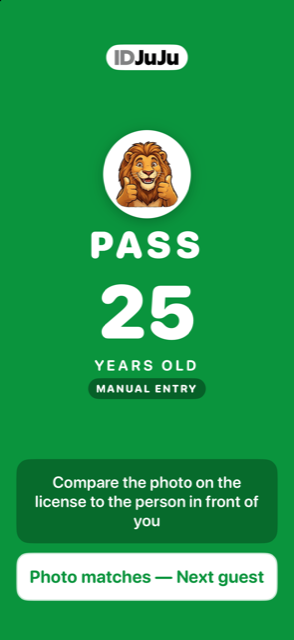
Green PASS screen showing an age of 25
PASSGreen, with the age. Compare the photo on the card to the person, then tap to confirm.
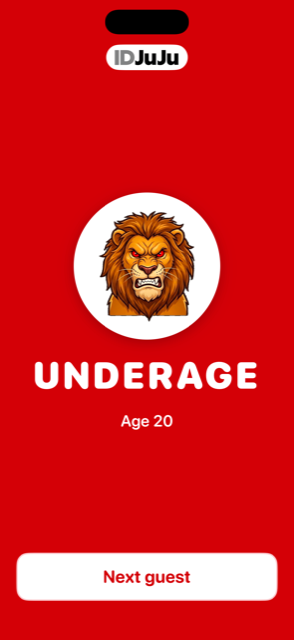
Red UNDERAGE screen showing an age of 20
UNDERAGERed, with the age. No confirmation step, no ambiguity, no argument.
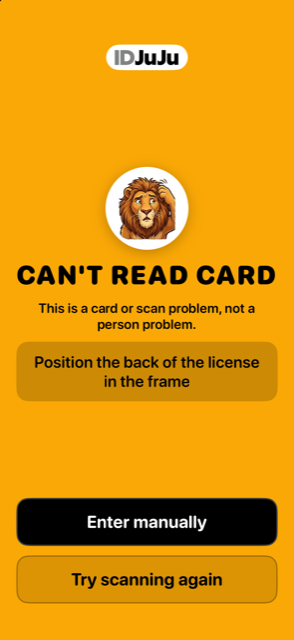
Amber CAN'T READ CARD screen
CAN'T READ CARDAmber. A worn card is a card problem, not a person problem — type it in instead.
Why it holds up

Built for a doorway, not a desk

Every decision in this app came from standing at a door with a queue behind the person in front of you.

1

Works with no signal

The app makes no network call while scanning. A dead venue Wi-Fi or a packed stadium cell tower changes nothing.

2

Nobody logs in

There are no user accounts. Hand a host the phone and they are working. The password only guards exports and settings.

3

The photo check is built in

A pass is not finished until the host confirms the photo matches. The app will not move to the next guest until they do.

4

Records never sit in the open

Every scan is written to encrypted storage on the phone. There is no cloud account behind the app and no third party in the middle.

5

Manual entry that still counts

Damaged cards get typed in and are marked as manual, so the report shows exactly how many were handled that way.

6

Clearing is deliberate

Records cannot be wiped until they have been exported, and only an administrator can do it.

For door staff

Working the door

Five things to know. That is the entire job.

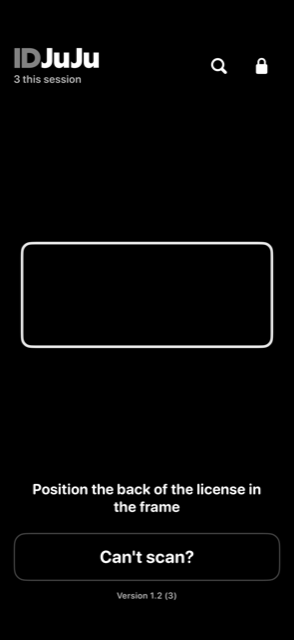
The scan screen with the licence frame
1

Hold the back of the card in the frame

The barcode is on the back of a driver's licence, not the front. Fill the frame with it. The app reads it on its own — there is no shutter button to press.

If the screen says Tap to scan, the camera has paused to save battery. One tap wakes it.
Green pass screen with the confirm button
2

Green means look at the photo

PASS tells you the card says the guest is old enough. It does not tell you the card belongs to them. Compare the photo to the face in front of you, then tap Photo matches — Next guest.

That tap is the record. Until you press it, the app is still waiting on you.
Red underage screen
3

Red means no, and it shows the age

You can turn the screen around and show them. The number came off their own card, which takes the argument off you and puts it on the arithmetic. Tap Next guest and carry on.

Amber can't read card screen
4

Amber means try again, then type it

Wipe the card, flatten it, and tap Try scanning again. Plenty of cards are just worn out. If it still will not read, tap Enter manually.

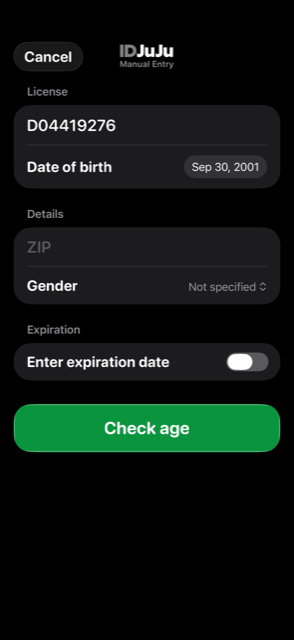
Manual entry form
5

Manual entry

Type the licence number and set the date of birth from the front of the card, then tap Check age. You get the same green or red answer, and the record is flagged as manual so the report is honest about it.

Never wave someone through because the card would not scan. Manual entry takes fifteen seconds and leaves a record.
For supervisors

Closing out a shift

The supervisor password opens the event details and the three export buttons. Nothing else about the app changes.

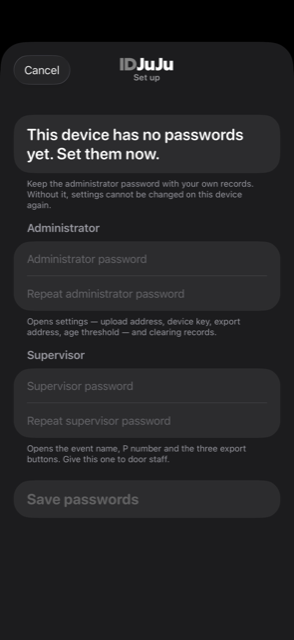
First run password setup screen
1

A new phone asks for two passwords

The first time anyone opens the padlock on a fresh phone, it asks for an administrator password and a supervisor password. Door staff get the supervisor one. The administrator one stays with the manager.

If the phones are managed centrally, the passwords arrive with the app and this screen never appears.
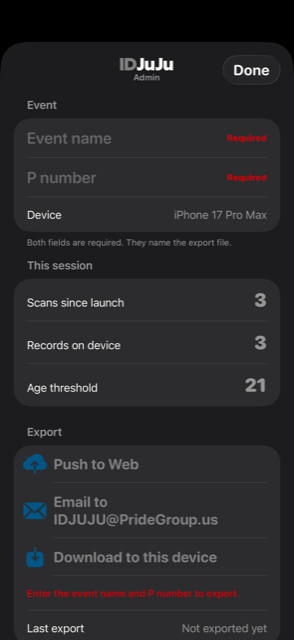
Admin screen with event name and P number required
2

Name the event before you export

Tap the padlock, enter the supervisor password, then fill in the Event name and P number. Both are marked Required because they become the file name.

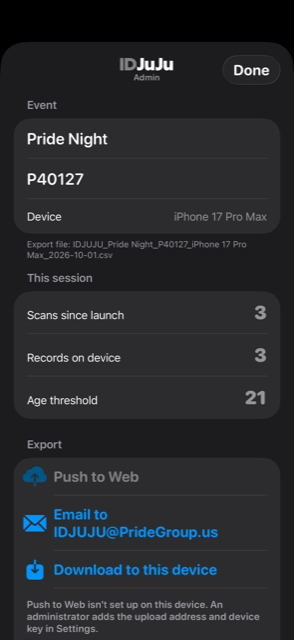
Admin screen with the event filled in and export file name shown
3

Check the counts and the file name

The app shows you the file it is about to produce, the number of records on the device, and the age threshold in force. If the record count looks wrong, sort that out before you export.

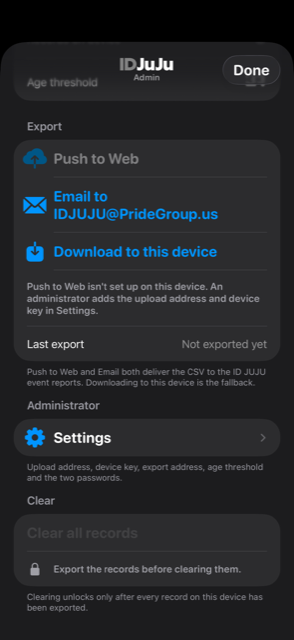
The three export buttons
4

Send it one of three ways

Push to Web uploads straight into the Pride Group site and builds the event report. Email sends the spreadsheet to the ID JuJu mailbox. Download to this device is the fallback when you have neither.

Push to Web stays greyed out until an administrator has entered the upload address and device key. Email always works.
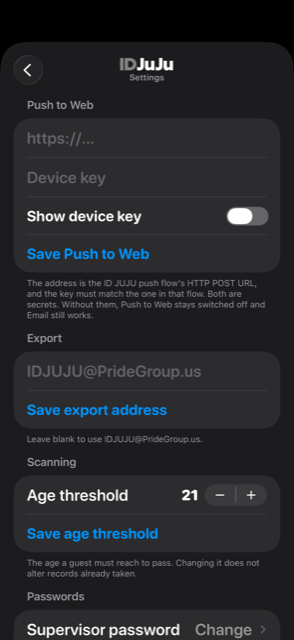
Administrator settings screen
5

Administrators only: Settings

Behind the administrator password sit the upload address, the device key, the export address, the age threshold, and both passwords. There is also Erase settings on this device, for when a phone leaves your hands.

Clearing the records only unlocks after every record on the phone has been exported. Confirm the file arrived first.
After the event

What lands on your desk

An export is not a pile of raw scans. It arrives named, filed, de-duplicated, and summarised — ready to hand to a venue, an insurer, or a licensing officer.

Every file names itself

The event name, the P number, the phone, and the date are baked into the file name, so two doors at the same event never collide.

IDJUJU_Pride Night_P40127_Door 1 iPhone_2026-10-01.csv

The event summary

Each upload rebuilds a workbook for that P number with a Summary tab and every entry behind it. Push the same shift twice and the duplicates are ignored — the totals do not move.

416
Total entries
3
Devices
11
Manual entries
7
Under 21 at scan

Example figures, shown to illustrate the layout.

Guests by gender marker

206 198 12 Male Female Other

Drawn from the markers printed on the cards themselves.

Behind the summary, every entry

ScannedLicenceAgeResultEntryDevice
2026-10-01 20:14D0441927625PassScanDoor 1 iPhone
2026-10-01 20:15D0887314220UnderageScanDoor 1 iPhone
2026-10-01 20:17C774190334PassManualDoor 2 iPhone
2026-10-01 20:18D1129045529PassScanDoor 1 iPhone

Example rows. Each export also records the ZIP and gender marker from the card, and whether the guest was under the threshold at the moment of the scan.

Where it all lives

Everything goes to Pride Group's own Microsoft 365 site, in one folder with three rooms: EXPORTS holds the raw CSV from each phone, REPORTS holds the per-event workbook that staff actually read, and SYSTEM holds the template and the script that builds them. Nothing passes through anyone else's service on the way.

Support

When something is not behaving

Six things cover almost every call we get.

The card will not scan

Wipe it, flatten it, fill the frame with the barcode on the back. Then use Can't scan? → Enter manually.

The camera frame is black

Tap once to wake it. If it stays black, open iPhone Settings, find ID JUJU, and switch Camera on.

It is asking for a password

That is the admin screen. Door staff use the shared supervisor password; your manager holds the administrator one.

The export buttons are greyed out

Fill in the event name and P number, and check the phone actually has records on it.

Push to Web does nothing

It needs the upload address and device key, which an administrator adds in Settings. Email and Download work without them.

Did the records send?

Look for the file in the ID JuJu folder or the mailbox before clearing anything. Clearing cannot be undone.

Still stuck?

Email us with the event, the date, and which phone — the device name is on the admin screen.

IDJUJU@PrideGroup.us